

E. Wade Ballou, Jr. was appointed to a position in the Office of the Legislative Counsel of the U.S. House of Representatives in 1983. For the ensuing 41 years he had the privilege and responsibility of providing legislative counsel services to the Members of the House of Representatives, culminating with an appointment as the 8th Legislative Counsel of the U.S. House of Representatives in 2016. This paper arises from Wade’s experiences in the Office of the Legislative Counsel as well as from is participation in many conferences, webinars, and conversations with colleagues from around the world which were primarily facilitated by Bússola Tech (www.bussola-tech.co), to whom I am indebted for the development of the thoughts contained in this paper. In addition, I received assistance in research and writing from AI, especially from Google’s Gemini and Notebook and MS Copilot.
Executive Summary
Congress faces declining institutional power and capacity at a time when legislative demands, information volume, and the need for precise statutory drafting are increasing. Rapid advances in artificial intelligence and the Supreme Court’s decision in Loper Bright Enterprises v. Raimondo create an opportunity—and a need—for Congress to strengthen its Article I capabilities. This paper proposes a Data-Informed eLegislative Framework: an enterprise architecture that organizes societal and authoritative legal information into governed data streams, supports rigorous analysis before enactment, assists Members and legislative professionals throughout drafting and deliberation, and enables continuous oversight after enactment.
The framework is designed to augment—not replace—human judgment. It would connect existing congressional systems, preserve institutional knowledge, improve the identification of statutory gaps and conflicts, and produce structured, machine-readable data and associated documentation tied to legislative purposes and measurable outcomes. Its success would depend on enterprise governance, strict security and confidentiality controls, authoritative data stewardship, transparent and auditable AI tools, and clearly assigned responsibility across congressional offices and support institutions. Implemented incrementally, the framework could improve legislative precision, reduce dependence on administrative gap-filling, and give Congress a stronger basis for evaluating whether enacted laws achieve their intended results.
Recommendations
Establish enterprise governance. Create a bicameral governance structure with clearly assigned responsibility for architecture, standards, funding, procurement, security, privacy, and institutional accountability.
Build on existing congressional systems. Connect and strengthen Congress.gov, govinfo.gov, USLM XML, committee systems, Member-office records, and the systems maintained by legislative support offices rather than creating a disconnected replacement platform.
Govern two distinct data streams. Maintain separate controls for societal information and authoritative legal materials, with source validation, provenance, version control, chain-of-custody metadata, and appropriate retention rules.
Preserve human judgment and confidentiality. Require Members and legislative professionals to remain responsible for policy, legal, and drafting decisions, while protecting confidential communications, drafting requests, work product, and personally identifiable information.
Deploy AI tools incrementally and transparently. Begin with bounded uses such as validation, comparison, conflict detection, and technical-error review; test tools against documented standards; retain audit trails; and require human evaluation of consequential outputs.
Integrate analysis into drafting. Use the Four Clarifying Questions to define the problem, solution, administrative and enforcement structure, effective date, and applicability rules before and during the drafting process.
Design oversight before enactment. Include statutory metrics, reporting schedules, publication requirements, and specifications for structured, machine-readable data and associated documentation in legislation so Congress can evaluate implementation and outcomes.
Implement through phased pilots. Test the framework in legislative domains selected through bicameral governance, establish baselines, measure accuracy, timeliness, analytical value, security, confidentiality, and staff workload, and expand only those capabilities that demonstrate institutional benefit after independent review.
Modernizing legislative operations requires more than the ad hoc adoption of contemporary software by individual offices. Congress needs an intentional enterprise architecture for receiving information from society and the other branches, governing and processing that information, and structuring legal materials—especially legislative information—for use throughout the legislative process.
This paper considers how Congress can use two catalysts—developments in artificial intelligence and the Supreme Court’s decision in Loper Bright Enterprises v. Raimondo, 603 U.S. 369 (2024)—to modernize its operational architecture and establish a Data-Informed eLegislative Framework. It describes Congress’s institutional decline, proposes an enterprise data architecture for legislative information, explains how that architecture would support drafting and deliberation, and concludes with a framework for post-enactment oversight.
Congress’s Constitutional Role and Institutional Capacity
Article I establishes the Federal Government’s legislative branch, vests in Congress the legislative powers granted by the Constitution, and places Congress within a system of separated powers and checks and balances. The Federalist Papers explain central features of this design. Federalist No. 51 observes that, in republican government, legislative authority necessarily predominates, while Federalist No. 10 describes representation as a means “to refine and enlarge the public views” through a chosen body capable of discerning the country’s true interests. In McCulloch v. Maryland, 17 U.S. (4 Wheat.) 316, 421 (1819), the Supreme Court explained that the Necessary and Proper Clause permits Congress to select appropriate means, consistent with the Constitution, to carry its enumerated powers into execution. The Federalist No. 51, at 321–22 (James Madison) (Jacob E. Cooke ed., 1961); The Federalist No. 10, at 62 (James Madison) (Jacob E. Cooke ed., 1961); McCulloch v. Maryland, 17 U.S. (4 Wheat.) 316, 421 (1819).
Against this historical backdrop, commentators and public officials have described a shift of institutional power away from Congress and toward the Executive Branch. Justice Robert H. Jackson addressed that imbalance in his concurring opinion in Youngstown Sheet & Tube Co. v. Sawyer, 343 U.S. 579, 653–54 (1952), emphasizing both the growth of presidential power and Congress’s responsibility to preserve its own constitutional authority.
“[I]t is relevant to note the gap that exists between the President’s paper powers and his real powers. The Constitution does not disclose the measure of the actual controls wielded by the modern presidential office. That instrument must be understood as an Eighteenth-Century sketch of a government hoped for, not as a blueprint of the Government that is. Vast accretions of federal power, eroded from that reserved by the States, have magnified the scope of presidential activity. Subtle shifts take place in the centers of real power that do not show on the face of the Constitution.”Youngstown Sheet & Tube Co. v. Sawyer, 343 U.S. 579, 653–54 (1952) (Jackson, J., concurring).
He then observed that the decline of the exercise of legislative power by Congress is self-inflicted:
“But I have no illusion that any decision by this Court can keep power in the hands of Congress if it is not wise and timely in meeting its problems. A crisis that challenges the President equally, or perhaps primarily, challenges Congress. If not good law, there was worldly wisdom in the maxim attributed to Napoleon that ‘The tools belong to the man who can use them.’ We may say that power to legislate for emergencies belongs in the hands of Congress, but only Congress itself can prevent power from slipping through its fingers.” Youngstown Sheet & Tube Co. v. Sawyer, 343 U.S. 579, 654 (1952) (Jackson, J., concurring).
Congress now confronts a complex society, compressed legislative calendars, and an overwhelming influx of unstructured data while its institutional power continues to decline. In 2016, Speaker Ryan’s “Better Way” called, among other objectives, for restoring Congress’s constitutional authority.House Committee on Natural Resources, Bishop: GOP Plan Will Empower Citizens Over Bureaucracy, Restore Constitutional Separation of Powers (June 16, 2016), https://naturalresources.house.gov/news/documentsingle.aspx?DocumentID=400800.
Despite that call for reform, Congress has not reversed the erosion of its institutional authority.
In an April 2, 2026, Harvard Kennedy School account of his appearance at the Institute of Politics, former Speaker Paul Ryan addressed executive encroachment on Congress’s appropriations authority and the institutional incentives that can discourage a congressional majority from resisting a President of the same party. He described the power of the purse as central to Article I, characterized the Legislative Branch as the Constitution’s more powerful branch, and observed that unified party control can make a congressional majority reluctant to resist a President who leads the party.Susan A. Hughes, Paul Ryan: “Nothing Is Permanent. Come 2028, We’ll See What Happens,” Harvard Kennedy School (Apr. 2, 2026), https://www.hks.harvard.edu/faculty-research/policy-topics/public-leadership-management/paul-ryan-nothing-permanent-come-2028.
Robert Draper’s September 16, 2026, New York Times Magazine article “Congress May Be Broken Beyond Repair. Lawmakers Told Us How It Happened.” reports lawmakers’ accounts of the institutional incentives, procedural pressures, and political practices contributing to congressional dysfunction. Those accounts provide a contemporary perspective on the loss of legislative capacity described by Justice Jackson and former Speaker Ryan, while functioning as reported evidence rather than an independent measure of institutional performance. Robert Draper, Congress May Be Broken Beyond Repair. Lawmakers Told Us How It Happened., N.Y. Times Magazine (Sept. 16, 2026).
The Opportunity: AI, Loper Bright, and an eLegislative Framework
Two developments have arrived at this pivotal moment. First, rapid advances in artificial intelligence—particularly generative and agentic capabilities—provide new capacity to ingest, synthesize, structure, and analyze complex legislative and regulatory text at scale. Subject to validation, security, confidentiality, and human review, these tools can support scrutiny before and after enactment, identify potential gaps, and assist analysis of possible policy effects. Second, the Supreme Court’s decision in Loper Bright Enterprises v. Raimondo, 603 U.S. 369 (2024), reshaped administrative law by overruling Chevron U.S.A. Inc. v. Natural Resources Defense Council, Inc., 467 U.S. 837 (1984). Under Loper Bright, the Administrative Procedure Act requires courts to exercise independent judgment on questions of statutory meaning and prohibits deference to an agency’s interpretation merely because the statute is ambiguous. The decision does not eliminate agency policymaking discretion that Congress has lawfully conferred or the persuasive weight that an agency’s reasoning may receive. Loper Bright Enterprises v. Raimondo, 603 U.S. 369, 400–13 (2024); Chevron U.S.A. Inc. v. Natural Resources Defense Council, Inc., 467 U.S. 837, 842–44 (1984).
By requiring courts to exercise independent judgment on questions of statutory meaning, Loper Bright increases the practical importance of precise legislative drafting. Congress may still confer discretion on agencies within constitutional limits, but statutory text should identify the policy choices Congress has made, the boundaries of delegated authority, and the factors an agency may consider. Rigorous evidentiary analysis can help lawmakers distinguish intentional grants of discretion from omissions or ambiguities that invite avoidable litigation.
Congress can respond by developing an enterprise legislative data architecture and establishing an eLegislative framework. Emerging AI technologies, paired with robust human oversight, can expand the institutional capacity available to Congress as it responds to the drafting and oversight demands highlighted by Loper Bright. This architecture could strengthen analytical capacity, reduce avoidable ambiguity in statutory drafting, and support proactive oversight without overwhelming legislative staff. The system should be multilayered, designed for structured data ingestion, and integrated across the legislative process. As an end-to-end framework for digital constitutional governance, it would support precision drafting, pre-enactment conflict analysis, and systematic post-enactment scrutiny. In practical terms, Congress can begin by connecting its existing systems and addressing the gaps between them.
Enterprise-level development is essential because technological improvements can produce unintended institutional consequences. During the transition from handwritten manuscripts to digital files and PDFs, the operational boundary between legislative drafters and the Public Printer narrowed, but the substantive analytical capacity available to Legislative Counsel did not expand comparably. The bill-production process accelerated, yet polished digital typesetting sometimes concealed legal and structural errors. As political dysfunction has intensified pressure on legislative staff, modernization should therefore be judged not only by production speed but also by whether it improves analysis, accuracy, and institutional capacity. Don Wolfensberger’s recent opinion in The Hill, “Can You Measure a Congress’s Success?,” raises a related question about how institutional performance should be assessed. Don Wolfensberger, Can You Measure a Congress’s Success?, The Hill (Oct. 1, 2026), https://thehill.com/opinion/congress-blog/6120818-bipartisan-housing-act-success/.
Congressional technological modernization continues a long tradition of institutional adaptation. Congressional professionals have repeatedly updated legislative processes while respecting institutional prerogatives, practices, and traditions. Bills must be introduced in writing, but the method of producing that written form has evolved. By the early 1980s, the House Office of the Legislative Counsel was moving from electric typewriters to a central computer and line printer. A Member would place the resulting draft in the Hopper, after which the Clerk of the House sent it to the Government Printing Office—now the Government Publishing Office—for public printing. The Office also created a computer tape of each day’s introduced bills for GPO. By the mid-1990s, the Office was creating PDFs resembling the public prints with GPO-developed software, and GPO was producing public prints from the Office’s files rather than typesetting them anew. Today, draft legislation is produced in structured XML using United States Legislative Markup, a second-generation schema and information model derived from the international LegalDocML standard, Akoma Ntoso. GPO continues to produce the public prints, while PDFs produced by the House Legislative Counsel are commonly used in the House’s daily legislative process.See United States Legislative Markup, https://xml.house.gov/ ; OASIS, LegalDocumentML(Akoma Ntoso), https://www.oasis-open.org/standard/akomantoso/.
An Enterprise Legislative Data Architecture
Congress is both a producer and a consumer of information. In carrying out its Article I responsibilities, it produces official records that include statutory text, committee reports, hearing transcripts, oversight findings, and committee and floor debates. It also receives large volumes of specialized information from citizen petitions for redress of grievances under the First Amendment, executive agencies, nonpartisan support entities, academic institutions, industry stakeholders, and special-interest groups.
Congress does not coordinate this information sufficiently for consistent use as data throughout the legislative process. Retaining, archiving, and organizing it at the institutional level could provide the foundation for an integrated electronic legislative system. Such a system would convert fragmented information into structured, actionable knowledge and place accurate, contextual, and timely insights in the hands of elected representatives for decision-making.
Congress already maintains substantial legislative information assets. Congress.gov, operated by the Library of Congress, and govinfo.gov, operated by the Government Publishing Office, provide extensive public legislative data. Bills are drafted in USLM XML, supporting interoperability among the House and Senate Offices of the Legislative Counsel, the Clerk of the House, the Secretary of the Senate, the Government Publishing Office, the Library of Congress, and the Office of the Law Revision Counsel. The House and Senate, their committees, and individual Members also maintain websites, records, and specialized information systems. The principal problem is not the absence of systems but insufficient coordination among them: modernization efforts remain fragmented and siloed, limiting Congress’s ability to use information as an institutional resource.
Two Governed Data Streams
The eLegislative system can be understood as a continuous cycle supported by two distinct data streams. Each stream should retain separate governance, access, validation, provenance, and retention controls even when their outputs are brought together for authorized legislative analysis:
The societal data stream receives information from constituents and other public sources, including public-sentiment measures, real-world operational data, and socioeconomic indicators. Because civic data is often unstructured, noisy, and vulnerable to manipulation, artificial intelligence pipelines must apply documented controls for validation, provenance, representativeness, and bias testing. The architecture should prioritize primary-source data collected at the point of origin through ordinary processes in which real outcomes matter. Complementary datasets can then be used to test public claims, identify inconsistencies, and expose limitations or collection biases that require human evaluation.
The authoritative legal ingestion stream receives active statutory codes, enacted session laws, judicial precedents, regulatory filings, and constitutional mandates. Unlike societal inputs, these materials require legal precision, strict version control, and complete chain-of-custody metadata. Continuous stewardship should extend across the Offices of the Clerk of the House and the Secretary of the Senate; the House and Senate Offices of the Legislative Counsel; the Office of the Law Revision Counsel; the Government Publishing Office; and the Library of Congress, including the Congressional Research Service and Congress.gov.
The ingestion process requires technical, privacy, and security controls that protect information, legislative confidentiality, and internal systems. These safeguards should include:
Zero-trust controls, including API gateways and other approved security measures, to protect internal legislative networks from compromise of technical infrastructure.
Data-minimization and retention controls for external public feeds and processing tools, including contractual and technical restrictions that prevent unauthorized storage, reuse, training, or disclosure outside authenticated legislative boundaries while preserving records that Congress is legally or institutionally required to retain.
Automated PII-redaction and confidentiality pipelines for removing personally identifiable information from incoming data when appropriate, paired with authenticated internal boundaries that protect confidential communications, drafting requests, work product, and other information associated with Members and the legislative process.
From Data to Legislative Drafting
The resulting data is then made available for institutional use. Members considering legislation can use the same analytical framework that legislative counsel applies to organize relevant facts, legal authorities, and drafting choices without surrendering control over legislative objectives. The framework, known as the Four Clarifying Questions (4CQs), structures the inquiry while leaving Members to determine whether Congress should act, which values should govern, and which policy approach should be pursued:
Issue / Problem: What specific societal harm, market failure, regulatory deficit, or other issue is documented by the intake data?
Solution: Which legislative approaches could address the identified issue, and how do existing statutes, legal gaps, and the broader legal framework constrain or support those approaches?
Administration / Enforcement: What administrative responsibilities, enforcement mechanisms, reporting duties, and institutional roles are necessary to carry out the proposed solution?
Effective Date / Applicability: When should the proposed requirements take effect, which persons, conduct, transactions, or events should they govern, and what transition rules or exceptions are necessary?
This framework is particularly relevant after Loper Bright because it can help Congress state a statute’s scope and purpose, define the administrative and enforcement structure, specify effective-date and applicability rules, and identify the discretion conferred on an implementing agency. Those choices provide the legal framework an agency must follow when developing regulations after enactment and give reviewing courts clearer statutory direction.
The next phase connects data, AI tools, and human judgment. At this stage, a Member and the Member’s subject-matter specialists evaluate the identified issue, potential solutions, and the associated administrative, enforcement, and applicability considerations. Political values and policy priorities then shape the data-informed analysis into a specific legislative approach. The Member submits a request to Legislative Counsel that describes the problem and proposed solution as precisely as possible.
Legislative Counsel would process each request through its established iterative relationship with the Member, using AI tools only when they improve the quality and reliability of the draft. Existing tools already support XML validation, spell-checking, and the detection of technical errors. Future tools could identify internal conflicts, conflicts with current law, and execution problems; the Comparative Print Suite demonstrates the feasibility of structured comparison. Other tools could flag delegations of legislative authority that warrant review after Loper Bright and identify potential constitutional or subject-matter concerns for human evaluation.
As a proposal advances through the legislative process, the analytical tools can be reapplied after each negotiation, compromise, or amendment that modifies the text. Each iteration may change the underlying understanding of the issue or problem as additional Members shape the proposal.
The record of revisions should be identified and preserved so that Congress can decide which materials will accompany committee, floor, and final-passage deliberations. The Supreme Court’s use of legislative history is contested and varies by Justice, case, and type of material; it is therefore inaccurate to say categorically that the Court either disregards or relies on legislative history. The following empirical scholarship and commentary examine how judges use congressional materials and how assumptions about congressional practice influence statutory interpretation:
1. Abbe R. Gluck & Lisa Schultz Bressman, Statutory Interpretation from the Inside—An Empirical Study of Congressional Drafting, Delegation, and the Canons: Part I, 65 Stan. L. Rev. 901 (2013).
2. Abbe R. Gluck, Congress, Statutory Interpretation, and the Failure of Formalism: The CBO Canon and Other Ways That Courts Can Improve on What They Are Already Trying to Do, 84 U. Chi. L. Rev. 177 (2017).
3. Abbe R. Gluck & Richard A. Posner, Statutory Interpretation on the Bench: A Survey of Forty-Two Judges on the Federal Courts of Appeals, 131 Harv. L. Rev. 1298 (2018).
4. Abbe R. Gluck & Laila M. Robbins, The Enduring Relevance of Congress Despite the Court’s Shift to “Ordinary Reader” Statutory Interpretation, 33 J.L. & Pol’y 29 (2024).
5. Abbe R. Gluck, Legislative History Lives On—In Secret, SCOTUSblog (Apr. 9, 2026), https://www.scotusblog.com/2026/04/legislative-history-lives-on-in-secret/.
6. Abbe R. Gluck, Justice Jackson Reignites the Interpretation Wars, Adding to Textualism’s Emerging Cracks, SCOTUSblog (July 7, 2026), https://www.scotusblog.com/2026/07/justice-jackson-reignites-the-interpretation-wars-adding-to-textualisms-emerging-cracks/.
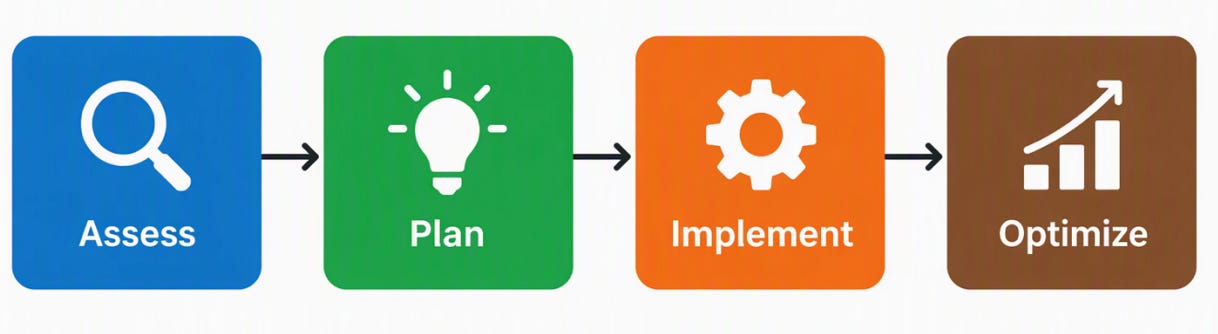
Four-step cycle illustrated on page 11 of the original PDF.
The framework operates as a continuous four-step cycle governed by the policy objectives, political values, and ideological judgments of Members. Assess uses governed societal and legal data to define the problem, identify statutory gaps or conflicts, and establish a baseline without displacing a Member’s authority to determine which issues warrant legislative action. Plan applies the Member’s policy priorities and political philosophy to that analysis to develop a legislative approach, including the policy solution, administrative and enforcement structure, effective date, applicability rules, and measurable outcomes. Implement carries the Member-directed approach through drafting, deliberation, enactment, administration, and required reporting, with Members and legislative professionals retaining responsibility for consequential decisions. Optimize compares implementation data and observed outcomes with the statute’s purposes, the Member’s policy objectives, and the specified metrics, identifies necessary corrections, and feeds the resulting evidence into the next assessment.
The stages are iterative rather than mechanically sequential. New evidence, negotiation, amendment, implementation experience, or a change in Member priorities may return a proposal to an earlier stage. At every stage, data and AI tools inform analysis but do not select legislative objectives, resolve political judgments, or determine whether Congress should act; those decisions remain with Members, supported by legislative professionals operating within their respective institutional roles.
Designing for Post-Enactment Oversight
Post-enactment oversight begins before enactment, when Congress controls the legislative process and can specify the form, frequency, and purpose of later review. Legislation may require an implementing Secretary to report once or periodically on actions taken, problems encountered, and results measured against statutory purposes and metrics selected by Congress. In the post-Loper Bright environment, those requirements can also prescribe structured, machine-readable data and associated documentation sufficient for Congress to evaluate implementation without delegating the selection of legislative objectives to an agency or automated system. Where consistent with security, privacy, confidentiality, and other legal constraints, agencies should publish the required data for use by Congress, civil society, and other interested persons.
An eLegislative framework should also account for matters on which Congress does not develop or enact legislation. Congress may choose not to act, but information received from society should remain available, subject to applicable retention, privacy, and confidentiality rules, for later legislative analysis. The decision not to act—and the reasons for it—may inform subsequent deliberation, oversight, and public accountability.
Implementation should proceed through bounded pilots selected by bicameral governance and conducted in legislative domains where authoritative data, institutional ownership, and measurable workflows are already available. Each pilot should establish a baseline, define success measures for accuracy, timeliness, analytical value, security, confidentiality, and staff workload, and undergo independent review before expansion. Congress should scale only those capabilities that demonstrate institutional benefit while preserving Member control, legislative-office responsibilities, and existing protections for confidential work.
The framework remains a proposed institutional design rather than a validated operational system. Before implementation, Congress would need to resolve questions of bicameral authority, appropriations, procurement, records ownership, retention, access controls, cybersecurity, privacy, legislative confidentiality, model and vendor accountability, interoperability, and responsibility for errors or disputed outputs. Pilot evaluations should therefore distinguish demonstrated capabilities from anticipated benefits and should document limitations, failure modes, costs, and effects on existing institutional roles.
Conclusion: Reclaiming Legislative Capacity
A Data-Informed eLegislative Framework would do more than modernize congressional technology. By integrating governed data, disciplined analysis, human judgment, precision drafting, and continuous oversight, it could strengthen Congress’s capacity to exercise its Article I responsibilities throughout the legislative life cycle. Its success should be measured by demonstrated improvements in legislative accuracy, institutional memory, Member control, confidentiality, and oversight—not by the deployment of artificial intelligence itself. In the post-Loper Bright era, building this capacity offers Congress a practical means to reclaim legislative responsibility and reinforce its role as the Nation’s representative lawmaking body.
